Explainer: How Infrared Thermometry Works Without Contact
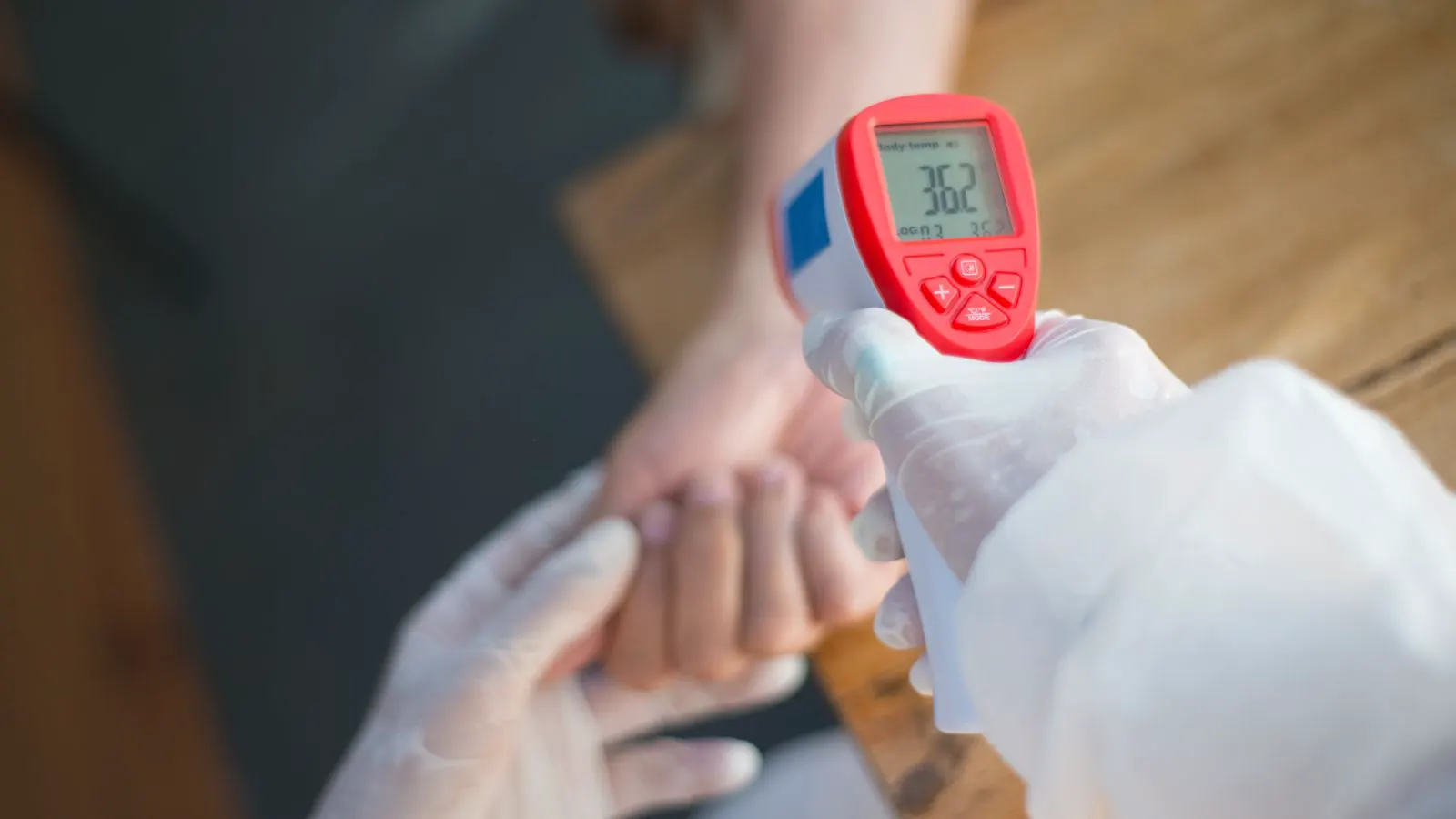
Infrared thermometry measures the thermal radiation emitted by a surface to determine temperature without physical contact. The method relies on the Stefan-Boltzmann law and Planck's distribution. Accuracy depends on surface emissivity, ambient conditions, and the distance between the sensor and target. Understanding these factors is key to selecting the right non-contact temperature sensor for industrial applications.
- Infrared thermometry measures thermal radiation rather than conductive heat transfer.
- Surface emissivity is the primary variable that affects measurement accuracy.
- Distance and atmospheric interference can degrade signal quality over long ranges.
- Selecting the right sensor requires matching the optics and wavelength to the target material.
What is infrared thermometry?
Infrared thermometry is a method of measuring temperature by detecting the infrared radiation emitted by an object. All materials above absolute zero emit thermal radiation. The amount of this radiation increases with temperature. An infrared sensor detects this energy and converts it into an electrical signal. This signal is then processed to display a temperature reading.
This technique is distinct from contact methods. Contact sensors, such as thermocouples or RTDs, must touch the object to measure temperature. They rely on the laws of thermodynamics. Infrared sensors, by contrast, measure the radiation emitted by the surface. This allows for monitoring of high heat sources, moving parts, or hazardous environments. It also enables rapid scanning of large areas.
The physics behind the measurement
The core principle behind infrared thermometry is the Stefan-Boltzmann law. This law states that the total radiant energy emitted per unit surface area of a black body is proportional to the fourth power of its absolute temperature. A black body is an idealized surface that absorbs all incident radiation. No real material is a perfect black body. They all have some reflectivity and transmissivity.
The amount of radiation emitted by a real surface is determined by its emissivity. Emissivity is a dimensionless value between 0 and 1. A surface with an emissivity of 1 emits the maximum possible radiation. A surface with an emissivity of 0 emits none and reflects all incoming radiation. Most industrial materials fall between these extremes. Polished metals have low emissivity. Oxidized metals, ceramics, and painted surfaces have high emissivity.
The sensor does not measure temperature directly. It measures the radiance of the target. The instrument uses a calibration curve based on Planck’s law to convert this radiance into a temperature value. This calculation assumes a specific emissivity value. If the actual emissivity of the target differs from the assumed value, the reading will be inaccurate.
How emissivity affects accuracy
Emissivity is the most critical factor in infrared thermometry. It determines how much of the thermal radiation is actually emitted by the surface. A low emissivity surface reflects a significant amount of ambient radiation. This reflected radiation adds to the measured signal. It creates a false reading that is higher than the actual surface temperature.
For example, a polished steel plate may have an emissivity of 0.1. It reflects 90% of the surrounding heat. If the sensor detects 90% of the ambient radiation and 10% of the actual surface radiation, the calculation will be skewed. The reading will be too high. To correct for this, the operator must adjust the emissivity setting on the instrument to match the surface.
High emissivity surfaces are easier to measure. They emit more of their own thermal energy. They reflect less of the ambient heat. This makes them more reliable targets. In industrial practice, many engineers apply a high emissivity paint or tape to shiny surfaces before taking measurements. This creates a temporary, stable surface with known properties.
Distance and atmospheric effects
The relationship between distance and accuracy is governed by the optics of the sensor. Most infrared sensors have a specific field of view. This is the angular area the sensor can see. The size of the measurement spot on the target increases with distance. A sensor with a 1:10 field of view will have a spot size that is ten times the diameter of the lens.
At short ranges, the sensor sees a small, uniform area of the target. This is ideal. At long ranges, the spot size grows. The sensor may pick up heat from adjacent objects. It may also see cooler ambient air. This reduces the accuracy of the reading. The rule of thumb is that the spot size should be at least ten times larger than the target area.
Atmospheric conditions also play a role. Water vapor, carbon dioxide, and other gases absorb specific wavelengths of infrared radiation. Long-wavelength infrared sensors are less affected by atmospheric absorption. They are better suited for outdoor or dusty environments. Short-wavelength sensors are more sensitive to these factors. They are better for clean, indoor applications.
Practical considerations for sourcing
When selecting an infrared sensor, you must consider the target material and the environment. The table below outlines the key factors to evaluate.
| Factor | Description | Impact on Selection |
|---|---|---|
| Emissivity | Surface property affecting radiation emission | Low emissivity requires correction or surface prep |
| Distance | Range between sensor and target | Long distances require larger optics and higher power |
| Wavelength | Peak emission of the target | Match sensor wavelength to target emission |
| Response Time | Speed of temperature change | Fast processes require high-speed detectors |
| Environmental | Dust, humidity, and ambient heat | Affects signal integrity and calibration |
The wavelength of the sensor must match the emission peak of the target. The peak emission wavelength of a black body is inversely proportional to its temperature. This is described by Wien’s displacement law. A target at 300 Kelvin emits radiation primarily in the mid-infrared range. A target at 1000 Kelvin emits in the near-infrared range. A broadband sensor measures multiple wavelengths. This provides a more stable reading. A narrowband sensor is more sensitive to changes in emissivity and atmospheric conditions.
Worked example
Imagine a machine operator needs to monitor the temperature of a hot exhaust pipe. The pipe is made of stainless steel and is painted black. The black paint has a high emissivity, close to 0.95. The pipe is located in a factory with ambient air at 25 Celsius. The exhaust gas inside the pipe is at 600 Celsius.
The operator uses a handheld infrared thermometer. The sensor is set to an emissivity of 0.95. The operator stands at a distance of 1 meter. The spot size is 100 millimeters. The pipe diameter is 150 millimeters. The spot size is smaller than the pipe diameter. The sensor sees only the pipe surface. It does not see the ambient air or other machinery. The reading is stable. The operator confirms the temperature is close to the expected value.
If the pipe were unpainted stainless steel, the emissivity would be much lower, perhaps 0.2. The sensor would see a lot of reflected heat from the surroundings. The reading would be unstable and likely too high. The operator would need to apply a high emissivity tape to a small area of the pipe. This creates a reliable measurement point. The reading would then be accurate and repeatable.
Common mistakes to avoid
A common mistake is assuming that all surfaces have the same emissivity. This leads to significant errors. Another mistake is not accounting for the distance. Standing too far away increases the spot size and introduces errors from the environment.
Operators often forget about the angle. Measuring at a shallow angle increases the apparent size of the target. It also increases the reflection of ambient heat. The sensor should be positioned as close to a normal incidence as possible.
Finally, many engineers neglect the calibration. Infrared sensors require regular calibration to ensure accuracy. The optics can degrade over time. The detector can drift. A regular maintenance schedule is necessary to keep the readings reliable.
Comparison with contact sensors
Infrared thermometry offers speed and safety. It can measure temperatures that would melt a contact sensor. It can monitor moving parts without wear. However, it is less accurate for low emissivity surfaces. It is also more sensitive to environmental changes.
Contact sensors, such as thermocouples and RTDs, are more accurate for steady-state measurements. They are less affected by emissivity. They can be embedded in the material. They provide a direct measure of the temperature. The choice between contact and non-contact depends on the application. For high heat, moving parts, or hazardous areas, infrared is preferred. For precise, static measurements, contact sensors are often better.
Conclusion
Infrared thermometry is a powerful tool for non-contact temperature measurement. It relies on the physics of thermal radiation. The accuracy of the measurement depends on the emissivity of the surface, the distance, and the atmospheric conditions. Understanding these factors is key to selecting the right sensor and getting reliable readings. By following best practices and understanding the physics, engineers can make informed decisions about their temperature monitoring systems.
Frequently asked questions
Can infrared thermometry measure through glass?
Standard glass blocks most infrared radiation. You cannot measure the temperature of a liquid behind glass with a standard infrared sensor. Specialized sensors are designed for specific wavelengths to see through certain types of glass or plastics.
How does emissivity affect the reading?
Emissivity determines how much heat the surface emits. Low emissivity surfaces reflect more ambient heat, which can cause the sensor to read higher than the actual temperature. High emissivity surfaces emit more of their own heat, leading to more accurate readings.
Is infrared thermometry better than thermocouples?
It depends on the application. Infrared is faster and safer for high heat or moving parts. Thermocouples are more accurate for steady-state, low emissivity surfaces. Choose based on your specific needs.
What is the best distance for measurement?
There is no single best distance. It depends on the sensor's field of view and the target size. The spot size should be at least ten times larger than the target area to ensure accuracy.
Do I need to calibrate my infrared sensor?
Yes. Regular calibration is necessary to ensure accuracy. The optics and detector can drift over time. A regular maintenance schedule is recommended.